
2026-04-08
Diabetic Eye Disease: Why Regular Eye Exams Matter
Diabetic and skipping eye check-ups? Big mistake. Here's what happens inside your eyes & why regular exams can save your sight.

Is LASIK surgery safe? Understand laser eye surgery risks & benefits. Learn if laser vision correction with LASIK eye surgery is right for you.
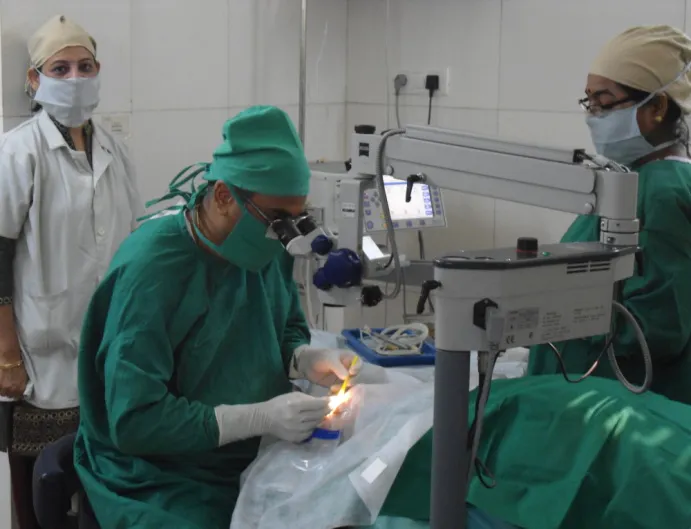
Alright, let's address the elephant in the room.
You've been thinking about LASIK. Maybe for months. Maybe for years. You're tired of fogging up your glasses every time you drink chai. You're done with contact lens drama - the dryness, the redness, that awful feeling when one lens decides to fold in half inside your eye.
But every time you seriously consider getting LASIK done, one question pulls you back:
"Is it actually safe?"
Fair question. Nobody wants someone pointing a laser at their eyeball without knowing exactly what they're getting into. And honestly? We respect that hesitation. At Shree Netra Eye Foundation, we've been in eye care since 1996, and we'd rather have a cautious patient than a reckless one.
So let's have a real conversation. No sugar-coating. No scare tactics. Just facts, some opinions from our experience, and everything you need to make an informed decision.

Quick recap for anyone who's new here.
LASIK stands for laser-assisted in situ keratomileusis. Fancy name, relatively simple concept. It's a type of refractive surgery where an eye surgeon uses a laser to reshape the cornea - that's the clear, dome-shaped front part of your eye. The goal of LASIK? Correct your refractive error so you can see clearly without glasses or contact lenses.
It works for myopia (nearsightedness), hyperopia (farsightedness), and astigmatism.
The surgeon creates a thin flap on the cornea, folds it back, then a precise laser reshapes the underlying corneal tissue. Flap goes back. Done. The whole thing takes maybe 15 minutes for both eyes.
Sounds straightforward, right? It mostly is. But "straightforward" and "risk-free" aren't the same thing.

Here's where people want hard data. And we don't blame them.
The success rate of modern LASIK is genuinely impressive. Multiple studies - including those referenced by the American Academy of Ophthalmology - put patient satisfaction rates somewhere between 95% and 98%. That's not a marketing number. That's decades of clinical data from millions of procedures worldwide.
Does that mean every single person walks out with perfect 20/20 vision? No. Some people end up at 20/25 or 20/30, which is still excellent for daily life - driving, working, most activities without glasses.
But here's what matters more than the success rate alone: the LASIK complication rate. Serious, vision-threatening complications? They occur in less than 1% of cases. We're talking extremely rare.
Now, does "extremely safe" mean zero risk? Nothing in medicine is zero risk. Like any surgery, LASIK involves some degree of uncertainty. But compared to many other surgical procedures - even compared to the cumulative risks of wearing contact lenses for 30 years - LASIK holds up remarkably well.

Let's split this into two buckets. Because there's a big difference between common side effects that go away and rare complications that actually matter.
Almost everyone experiences some of these in the first few days or weeks:
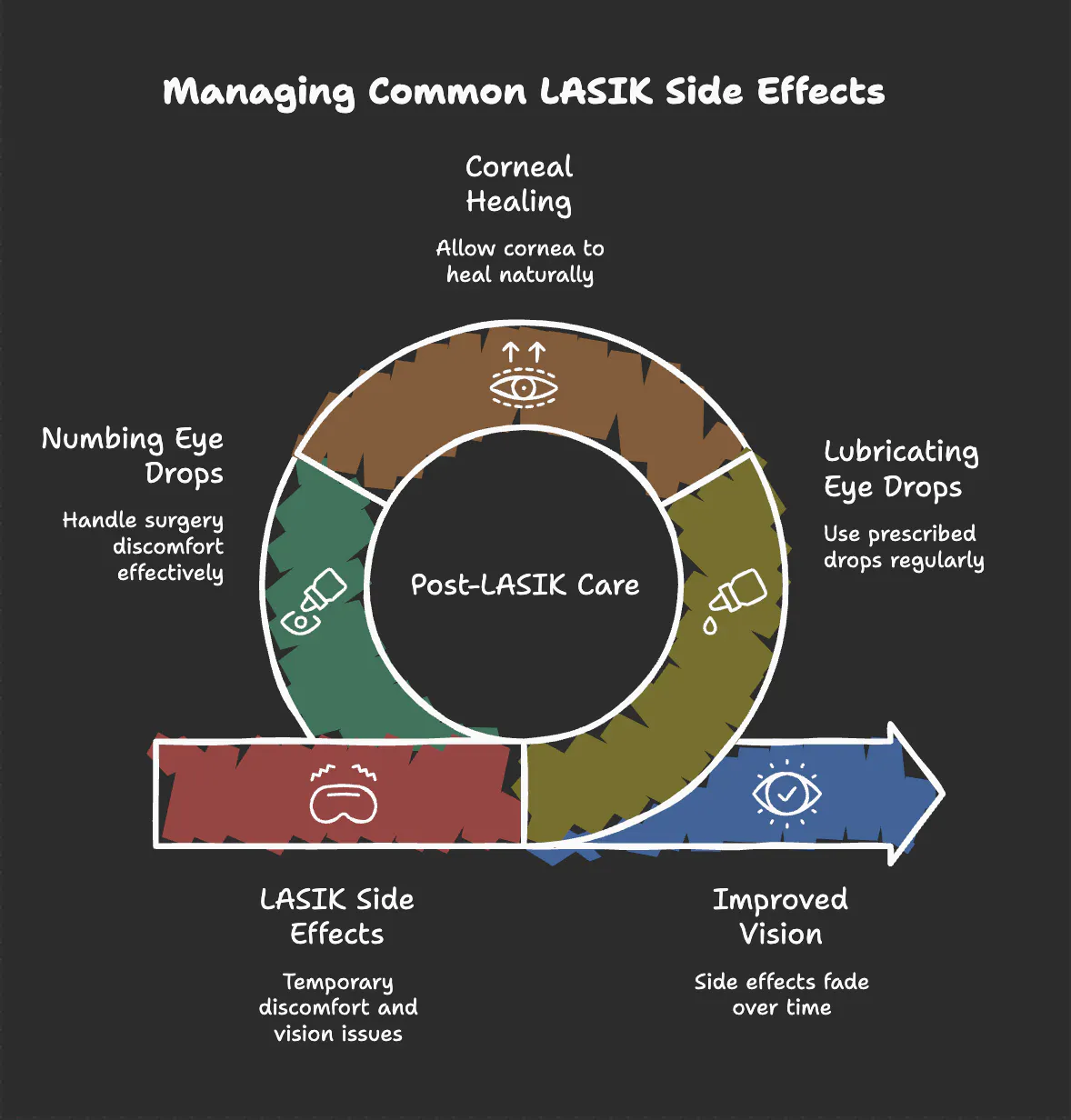
This is the most talked-about one. Your eyes might feel gritty, scratchy, or just... off. It happens because the surgery temporarily affects the corneal nerves that signal tear production. For most LASIK patients, this settles down within 3 to 6 months. Your eye doctor will prescribe lubricating eye drops - use them religiously.
Especially while driving at night. Lights might look a bit starburst-y or have rings around them. Annoying? Yes. Permanent? Almost never. This typically fades as your cornea heals.
Not pain exactly - more like a scratchy, watery feeling for the first day. Most people describe it as "weird but bearable." Numbing eye drops used during the procedure handle the actual surgery part.
Your eyesight might be a bit up and down for the first few weeks. One day crystal clear, next day slightly hazy. That's normal. The cornea is still settling into its new shape.
Here's the thing we tell every patient - these are expected parts of healing. They're not complications. They're your eye recovering from a surgical procedure, which is exactly what it should do.
Now the stuff that actually worries eye surgeons:
The corneal flap created during LASIK can occasionally shift, wrinkle, or develop irregularities. This is rare with experienced surgeons using advanced laser technology - and even rarer with bladeless femto LASIK where the flap creation itself is laser-guided rather than blade-based.
Extremely uncommon but possible. This is why post-operative care matters so much. Following your eye drops schedule, keeping your hands away from your eyes, wearing eye protection as advised - all of it reduces this risk to near zero.
This is when the cornea becomes progressively thinner and bulges after surgery. It's the complication that every LASIK surgeon screens for aggressively before clearing a patient. People with thinner corneas or certain corneal conditions are NOT good candidates for LASIK - and a responsible eye specialist will tell you that upfront.
Sometimes your eye power can shift back partially, months after surgery. It's not common with modern LASIK, but it happens. An enhancement surgery can usually fix it if needed.
While most dry eye cases resolve, a small percentage of patients experience longer-lasting dryness that requires ongoing management.
We're not listing these to frighten you. We're listing them because you deserve to know. And because knowing the potential risks actually helps you prepare better and choose better.
Not everyone who wants LASIK should get LASIK. And we say this as people who perform the procedure.
Here's what we look for when someone walks into Shree Netra Eye Foundation considering LASIK:
You should be at least 18 years of age - but honestly, we prefer patients to be in their early-to-mid 20s when eye power has stabilized. If your refractive error is still changing every year, LASIK can lead to underwhelming results.
Your prescription should have been consistent for at least 12 months. Fluctuating power means your eye is still changing, and reshaping the cornea now doesn't make much sense.
No active infections, no severe dry eyes, no corneal diseases, no uncontrolled glaucoma. A complete eye exam - including corneal thickness mapping, retina check, and tear film evaluation - tells us whether LASIK surgery requires a green light or a pause.
This one's on you. LASIK is brilliant, but it's not magic. If you expect supernatural vision with zero adjustment period, you'll be disappointed. If you expect freedom from glasses for most daily activities with a short recovery - that's realistic.
Hormonal changes can temporarily alter your refractive error. We ask women to wait until a few months after they've stopped nursing.
Here's a controversial opinion from our side: a good candidate for LASIK is someone whose eye surgeon has said NO to at least a few people that week. That tells you the surgeon is actually screening properly rather than just clearing everyone who walks through the door.
Let's weigh the risks and rewards honestly.
You wake up and see. No reaching for glasses. No lens solution bottles cluttering your bathroom. Sports, swimming, travelling - all without worrying about your vision correction gear. For most people, vision after LASIK stays stable for years and years.
Dry eyes settle. Halos fade. Mild discomfort disappears within a day or two.
The serious risks are genuinely rare - especially when the surgery is performed by an experienced eye surgeon using advanced laser technology, on a properly screened candidate.
Is it worth it? For many suitable candidates, yes - but it depends on your eyes, which is why a proper evaluation comes first.
LASIK isn't the only option out there. And sometimes it's not even the best one for a particular patient.
PRK surgery (photorefractive keratectomy) is similar to LASIK but without the corneal flap. Recovery takes a bit longer, but it's a solid choice for people with thinner corneas. Some surgeons actually prefer PRK for certain cases.
ICL (Implantable Collamer Lens) is great for people with very high refractive errors where LASIK may not be suitable. Think of it as a permanent contact lens placed inside the eye.
SMILE is a newer, minimally invasive laser vision correction procedure that's gaining popularity. Smaller incision, potentially fewer dry eye issues.
The point is - there are options. And a thorough consultation with your eye specialist should explore all of them before settling on one.
We've performed LASIK. We've also turned patients away from LASIK when the numbers didn't add up or when an alternative made more sense.
Here's what we always say at Shree Netra Eye Foundation: talk with your eye doctor openly. Ask uncomfortable questions. Understand the long-term effects. Look at your corneal scans. Discuss what happens if you need a cataract surgery decades later. Think about it.
LASIK is a laser eye surgery that has genuinely transformed millions of lives. Modern LASIK using advanced laser technology is safer, more precise, and more predictable than it's ever been.
But it's still surgery. It still requires the right candidate, the right surgeon, and the right expectations.
If you're in Kolkata and you've been considering LASIK, come see us at Ballygunge. We'll do a complete eye exam, run every diagnostic test that matters, and give you an honest answer - whether that answer is "yes, you're a great candidate" or "let's look at something else."
Because at the end of the day, your overall eye health matters more to us than any single procedure.
Eye care center treatments are specialized services aimed at improving and maintaining eye health
Diabetic and skipping eye check-ups? Big mistake. Here's what happens inside your eyes & why regular exams can save your sight.

Understand how glaucoma leads to vision loss. Learn about causes, risk factors, symptoms, angle-closure glaucoma, early detection and treatment options.
Is LASIK surgery safe? Understand laser eye surgery risks & benefits. Learn if laser vision correction with LASIK eye surgery is right for you.